
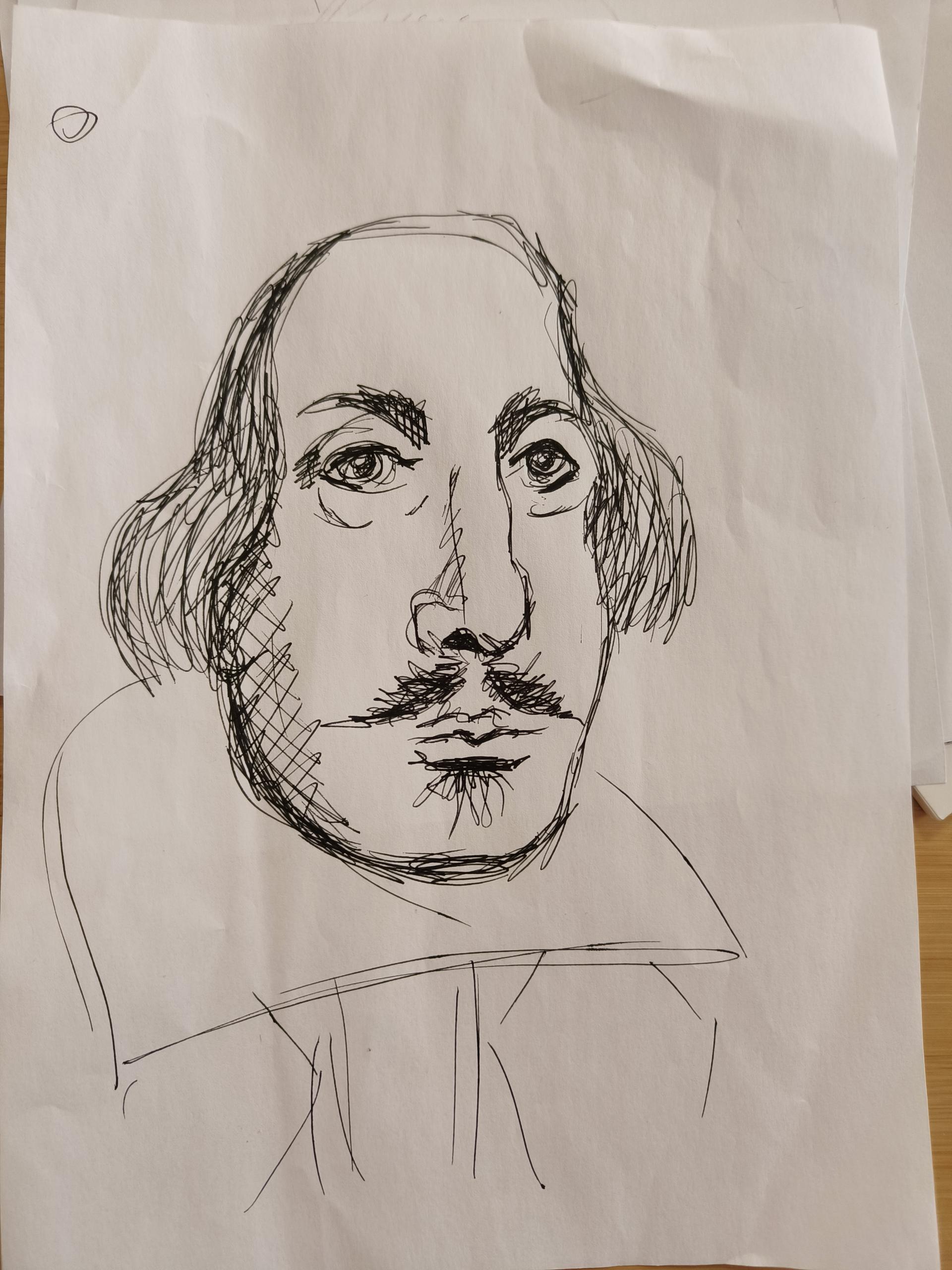
This discussion forum provides a space for my Grade 7 and Grade 8 students to discuss their research findings and identify connections on the subject of Shakespeare. other students are, of course, welcome to join the discussion 🙂
What to discuss? Well, here are a few prompts to get you started:
- Share interesting facts about Shakespeare’s life and the Elizabethan/Jacobean era.
- Identify common features of his plays (e.g., use of verse/prose, comedy/tragedy).
- Share relationship diagrams based on the play you’re reading.
- Comment on the status of women in Shakespeare’s plays.
- Share your favourite Shakespeare insults.
- Share Shakespeare memes.
Once comments have appeared below, the discussion can develop by responding to others 😉
Btw, you can read some student commentary on last year’s ‘all things Shakey’ discussion:
https://mushroom-scholars.org/appreciating-shakespeare
Has anybody read or seen Hamnet?
An idea about Ophelia
I’ve read Hamlet before and I have an idea about Ophelia. She goes crazy not just because her father was killed, but because one by one, her male protectors (the ones who have power that time) are no longer there for her. The only one who is still alive — her brother — is in France. When her father was killed and when she drowned herself, her brother was in France the whole time. Her father was the one with the power to protect the whole family. And then there was her lover, She tried to save him, but got rejected and hurt by Hamlet. So when love and protection all went away from her, she collapsed, and that’s how she became crazy and drowned herself.
Hiiii!! So I’ve made a relationship chart for the tempest made in the style of shipping charts (iykyk). Check it out and if I forgot anything, please tell me and I’ll improve it :3
I stole the title from https://www.thegreenroomtheatre.org/tempest/
😀
Edit: I only did the main main characters so yeah have fun with that info 🤷
Oh yeah the background is my notebook version so dr terret knows i did it not last minute totally not
Informative and colourful 🙂
Can we put it up on the wall 😀
Isn’t it Trinculo?
I have no idea lmao
Yes, good spelling catch 👍
The Tempest: Creative Insults (List for Notebook)
1. Prospero → Caliban
• “Hag-seed”
• “Poisonous slave”
• “A devil, a born devil”
• “What a thrice-double ass!”
2. Caliban → Prospero
• “You taught me language, and my profit on’t / Is I know how to curse.”
• “The red plague rid you!”
• “A plague upon the tyrant that I serve!”
3. Trinculo → Caliban
• “Puppy-headed monster!”
• “A most scurvy monster!”
• “What a pied ninny’s this!”
• “Thou scurvy patch!”
4. Stephano → Caliban
• “Why, thou debauched fish, thou!”
“Half a fish and half a monster!”
5. Nobles → Each Other
• “Most wicked sir, whom to call brother would even infect my mouth.”
• “Thine forward voice, now, is to speak well of thine friend; thine backward voice is to utter foul speeches and to detract.”
• “His complexion is perfect gallows.”
6. Boatswain → Nobles
• “Hang cur, hang, you whoreson, insolent noisemaker.”
Was it Boatswain said that to the nobles and not the other way round? No wonder they were irritated by his attitude!
Not-so-interesting facts about/related to Shakespeare:
1. He was often said to be gay by lots of people as he wrote sonnet 18 about a man (so why should we be even studying gay poetry in China?)
2. He didn’t often visit home later on as he was busy writing and staging plays
3. He married at an early age
4. Shakespeare was born 23rd April 1564
5. Shakespeare had seven siblings
6. Shakespeare had three children
7. Shakespeare moved to London as a young man
8. Shakespeare died on his birthday
9. Shakespeare penned a curse for his grave, daring anyone to move his body from that final resting place. His epitaph was:
Good friend for Jesus’ sake forbear,
To dig the dust enclosed here:
Blest be the man that spares these stones,
And curst be he that moves my bones.
10. Shakespeare was a Catholic
11. The longest word in Shakespeare is honorificabilitudinitatibus (IDK if that is even a true English word but I found that online)
12. Shakespeare lived through the Black Death
13. Shakespeare never attended university
14. Sources from William Shakespeare’s lifetime spell his last name in more than 80 different ways, ranging from “Shappere” to “Shaxberd”, so we may be spelling Shakespeare’s name wrong
If you cant see the meme bellow than it looks like this
You report that these are the ‘not-so-interesting facts’, so I’m looking forward to reading the interesting ones 😀
BTW “honorificabilitudinitatibus” is a rare Medieval Latin noun meaning “the state of being able to achieve honors” or “honorableness.” It’s also the longest word in English that alternates between consonants and vowels every letter : )
Interesting things about Shakespeare:
We don’t know Shakespeare’s exact birth date; there is documentary proof that Shakespeare was baptized on 26th April 1564, and scholars believe that, in keeping with the traditions of the time, he would have been baptized when he was three days old, meaning Shakespeare was probably born on April 23rd. However, as Shakespeare was born under the old Julian calendar, what was April 23rd during Shakespeare’s life would actually be May 3rd according to today’s Gregorian calendar.
Shakespeare married his wife, Anne Hathaway, when he was 18. She was 26 and three months pregnant with Shakespeare’s child when they married.
After marrying Anne Hathaway, he disappears from historical records for about seven years; people called that period his “lost years.”
Shakespeare wore a gold hoop earring in his left ear, which was a creative, bohemian look in the Elizabethan & Jacobean eras. This style is evidenced in the Chandos portrait, one of the most famous depictions of Shakespeare.
A funny meme of Shakespeare:
“The past tense of William Shakespeare would be ‘Wouldiwas Shookspeared”
The Status of women in “A Midsummer Night’s Dream”:
Hermia: Hermia’s status is lower when compared to other women (e.g Titania or Hippolyta) and faced a lot of struggles due to her disagreement with her father on her marriage. Her father, Egeus, planned to make her marry Demetrius, but she was already in love with Lysander. Her struggles focused on her marriage, and was spoken by powerful men. As an individual who had lower status, she navigated the rules of the Athenian society by refusing the marriage and insisted on loving Lysander.
Helena: Helena probably has the same status as Hermia, but she chose to put herself in an even lower position. Due to her intense love of Demetrius, she has put herself in an unhealthy self-denigrating and self-loathing disposition. Her struggles focused on Demetrius not loving her and having lower abilities to attract men than Hermia.
Hippolyta: Hippolyta has a higher status than Helena and Hermia (She was queen of the Amazons). There are no direct links to her struggles in the play. However, her agreeing to marry Theseus is representative of the fact that female strength and courage have been subordinated by male domination.
1. Interesting facts about Shakespeare’s life: Shakespeare’s parents made gloves for a living, and Shakespeare’s father at one point even got paid to drink beer. Shakespeare possibly wore a gold hoop earing. Shakespeare probably died on his birthday. A total of 13 suicides appeared in Shakespeare’s plays, and two of his plays were written completely in verse. Uranus’s moons were named after characters in Shakespeare’s plays. Shakespeare used 7000 words just once each in his plays. Shakespeare’s name got spelled 80+ different times in history–today’s spelling might not be the right one. Nobody knew what Shakespeare did during the period between 1585 and 1592. Shakespeare was lucky–he lived through the Black Death. North America’s 200 million starlings had to thank Shakespeare for their existence: In 1890 an American “bardolator” named Eugene Schiffelin decided to import every kind of bird mentioned in Shakespeare’s oeuvre but absent from the United States, so he released two flocks of 60 starlings in New York’s Central Park.
2. Common features about his plays: Shakespeare often used the iambic pentameter, soliloquies, and wordplay to add rhythm and deepness to the play. Second, his plays often explore topics of love, human nature, and human relationships.
Shakespeare memes
An interesting thing is, that Shakespeare only had one son in his whole life, called Hamnet, which died in 1596 at the age of 11. It could be implyed that, his son had a great influence on him which was shown in his famous play “Hamlet” which has a really similar name with Hamnet. And from my notes in A midsummer night’s dream, the most used device was using a pun, also what I remembered most clearly of. So from this I had a question of if Shakespeare’s play was written for the normal citizens or for the royal, high educated people. My guess is for both, and the pun may be quite obvious for all, in order for Shakespeare to be that famous, many people should understand his puns (wordplays). And most of his plays(almost all I think) had love between characters as a important part of the play, such as even in the Merchant of Venice, I remember that one reason that the women saved the Christian person was because she loved him or a friend of him(can’t remember clearly). And in most plays, the women loved someone as the play went on. The most funny insult in A midsummer night’s dream I think is the one Lysander said to Demetrius:”You have her father’s love, Demetrius; Let me have Hermia’s: do you marry him.” 🤣
In most Shakespeare plays women’s main role is to get married. Also in some plays, such as The Taming Of The Shrew, women who don’t want to get married are seen as weird and disliked by men, which is very unfair. Also in the taming of the shrew the “shrew” is a woman who doesn’t want to get married basically and the whole plot is people trying to make her get married. Another women’s role thing in the same play is how at the end the men have a kind of test to see who has a more obedient wife which is mean because they’re a wife not a servant. I’m not sure if I remembered it entirely correctly and I can’t fact check because school internet is not working so feel free to fact check.
Interesting facts about Shakespeare’s life: It was illegal for women and girls to perform in the theatre in Shakespeare’s lifetime so all the female parts were written for boys. The text of some plays like Hamlet and Antony and Cleopatra refer to that. It was only much later, during the Restoration, that the first woman appeared on the English stage.
Elizabethan era:he Elizabethan Era was a period of vibrant entertainment and cultural enrichment. The theatre, in particular, thrived during this time. The most famous venue was the Globe Theatre in London, where legendary playwright William Shakespeare premiered many of his timeless works.
Theatre performances were popular among people of all social classes, offering a wide range of plays, from tragedies and comedies to historical dramas.
Actors and playwrights were held in high regard, and their works contributed significantly to the cultural legacy of the era. Christopher Marlowe, Ben Jonson, and Thomas Kyd were among the other notable playwrights who gained prominence during this period.
Theatre was not only a form of entertainment but also a medium for reflecting and critiquing the society and politics of the time, making it a vital part of Elizabethan culture.
So that means:
Portia, who was played by a man, pretended to be a man which makes that a man playing a woman pretending to be a man. The more you know 🙂
Also imagine how awkward it was for the people in midsummer night, tempest, romeo and juliet and other romance plays :0
Good points!
I guess it might add to the comedy in the comedies, but it must’ve made it very challenging to act a serious tragedy.