
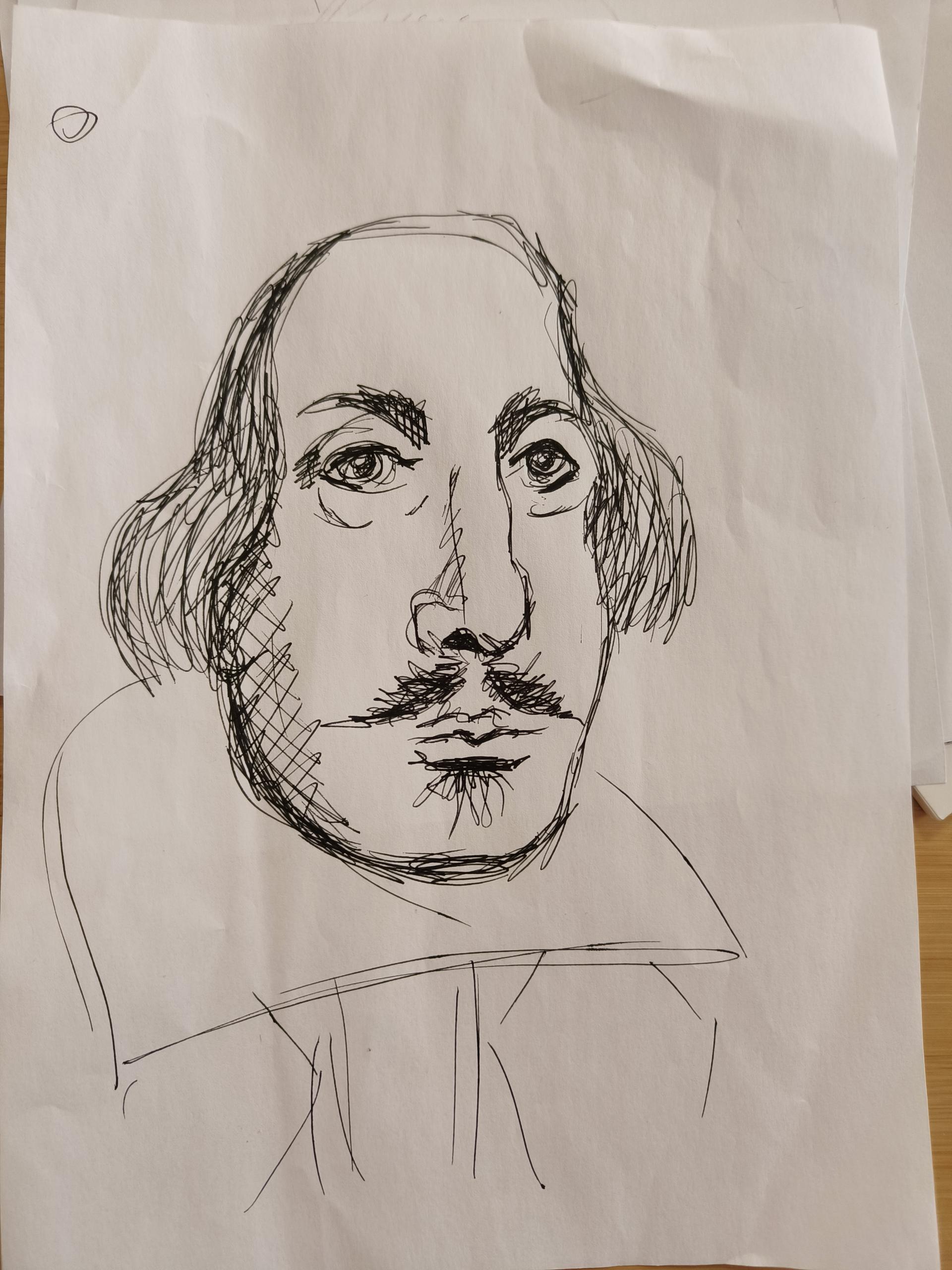
This discussion forum provides a space for my Grade 7 and Grade 8 students to discuss their research findings and identify connections on the subject of Shakespeare. other students are, of course, welcome to join the discussion 🙂
What to discuss? Well, here are a few prompts to get you started:
- Share interesting facts about Shakespeare’s life and the Elizabethan/Jacobean era.
- Identify common features of his plays (e.g., use of verse/prose, comedy/tragedy).
- Share relationship diagrams based on the play you’re reading.
- Comment on the status of women in Shakespeare’s plays.
- Share your favourite Shakespeare insults.
- Share Shakespeare memes.
Once comments have appeared below, the discussion can develop by responding to others 😉
Character relationship diagram
2. common features of Shakespeare’s play.: universal seems complex characters poetic devices, such as iambic pentameter, clever world played dramatic, conflict, and exploration of human nature
3. Status of woman(Miranda): throughout the whole play Miranda is treated as an object and she’s always under Prospero’s control .
Some evidences:” them as my gift and thine own acquisition worthily purchased, take my daughter”
“I have done nothing but in care of thee, my dear one, thee, my daughter.”
….
Shakespeare’s life and the Elizabethan/Jacobean era: William Shakespeare from 1564 to 1616, English playwright from Stratford-upon-Avon, role-plays and Sonus married Annie Hathaway, earned the globe Theatre in London together with others and retired home a literacy legend.
The Elizabeth and era(1558-1603), was England’s golden age of exploration, art, and power under Queen Elizabeth’I
1. The Elizabethan Era was the time of Queen Elizabeth’s reign, from 1558-1603. She was the daughter of Henry VIII and Anne Boleyn. She defeated the Spanish Armada (1588), strengthening England as a naval power and at the same time, encouraged exploration. During the Elizabethan Era, Sir Francis Drake became the first Englishman to circumnavigate the globe. while Sir Walter Raleigh founded the Roanoke colony in North America. The printing press was also invented during this time period.
2. Shakespeare mainly used iambic pentameter in his plays. Iambic pentameter, 5 pairs of unstressed and stressed syllables, was easy for actors to memorize. He also included blank verse, where he followed iambic pentameter but didn’t make it rhyme. His famous works include the Tempest, Romeo and Juliet, Julius Caesar and A Midsummer Night’s Dream.
3. My character relationship diagram is kinda hideous yeah it sucks so I’m not putting it here.
4. In The Tempest, Miranda is the only female character that appears on-stage. (Others, such as Sycorax and Claribel exist, but are only mentioned by the characters) She acts as the mistress of Prospero’s island.
5. Collection of Shakespeare’s insults: You mooncalf, pied ninny, jested monkey, scurvy patch, freckled whelp, sunburned sickleman, foot licker.
6. There are 3, this is only the first.
The second:
The third:
OK, there’s actually the fourth. I censored it.
So something interesting was in both of the Tempest, and the Midsummers night dream, the women both have a similar low status. However, in the tempest he narrative unfolds in a “normal” way, where the women in the end have to adapt to the choices there father have. But in Midsummers night the women flee from Athens. And this was interesting because I thought that this might have been shakespeares way to utilize the plays comedy status to challenge the traditional norms during the era.
Some thoughts about female characters:
Hippolyta:Represents higher class and traditional love,which forms a strong contrast with Helena&Hermia’s chaotic love.
Hermia:Was strangled to her father’s will,but has a spirit of resistance. She has less agency and status,but more courage.
Hermia’s happy ending(Marry Lysander) shows Shakespeare’s sympathy and wish to women’s low status situation
Helena:Unlike Hermia,Helena has no shackles.Is a free woman,but trapped in love. Her existence of being a “third person in love” let this play more chaotic
Titania:Similar to Helena. But Titania isn’t trapped in love,instead,she is trapped in the nominal husband and wife relation with Oberon.
Some interesting insults!
“Tempt not too much hatred of my spirit,for I am sick when I do look on there”—Demetrius
“Of all be hated,but most of me!”—Lysander
“You dwarf,you minimus,of hindering knot grass made;you bead,you acorn!”—Lysander
“Fie,fie!You counterfeit, you puppet,you!”—Helena
more info i got from last year wowza
o Was baptized on April 26, 1564
o Lived in Stratford and London
o Went to a good quality grammar school where he learnt Latin
o At the age of 18 he married to a 26 year old lady named Anne Hathaway
o He was an important member of the Lord chamerlain’s company of player (Or the King’s men)
o Had the best theater (AkA the globe)
even more wow my laptop is a gem mine of info
• He married a 26-year-old pregnant lady named Anne Hathaway when he was 18
• He left his wife his second-best bed
• He put a curse on his grave “Good friend for Jesus’ sake forbear,
To dig the dust enclosed here:
Blest be the man that spares these stones,
And curst be he that moves my bones.”
• He had 3 children
• He wrote at least 37 plays (Or 39 exactly according to another website), 154 sonnets and lots of poems (5 long narrative poems)
• Some of his best plays were Hamlet, Macbeth, King Lear, Romeo and Juliet, Midsummer night’s dream and Othello
wowza i wrote this last year. A diary entry as if shakey was the one who wrote it 😀
Dear Diary
During Shakey’s time, women were basically owned by their fathers. Then when a father aproves of a husband, he gives his daughter to the other man. This is seen in the Tempest where after Ferdinand and Miranda passed Prospero’s test(??), Prospero basically gives Miranda to Ferdinand. The three of them were in this scene yet Miranda barely got any lines.
One thing I remembered from memory from when I was studying The Tempest:
Shakespeare used verse for people with high status in his plays and also people with high status in the audience, he used prose for people with lower status in his plays and also people with lower status in the audience.
The Tempest: Insults
Act I
· “Hag-seed” (I.ii)
· “Poisonous slave, got by the devil himself / Upon thy wicked dam” (I.ii)
· “Freckled whelp, hag-born—not honoured with / A human shape” (I.ii)
· “Thou earth, thou!” (I.ii)
· “Thou, who art but air” (I.ii)
· “Dull thing, I say so” (I.ii)
· “Abhorred slave, / Which any print of goodness wilt not take” (I.ii)
· “Filth as thou art” (I.ii)
· “Tortoise” (I.ii)
· “Malignant thing” (I.ii)
Act II
· “Widow Dido” (II.i)
· “Widow! A pox o’ that!” (II.i)
· “The fault’s your own” (II.i)
· “Look, he’s winding up the watch of his wit; by and by it will strike” (II.i)
· “You were kneaded and clapped together” (II.i)
· “A most ridiculous monster” (II.ii)
· “How now, mooncalf!” (II.ii)
· “Mooncalf” (II.ii – used multiple times)
· “Puppy-headed monster” (II.ii)
· “Scandalous” (II.ii)
Act III
· “Idle hole” (III.i)
· “Foot-licker” (III.ii)
· “Deboshed fish” (III.ii)
· “How now, shall we? Do we not? What, all amort?” (III.ii)
· “Ignorant, long-tongued, babbling gossip” (III.ii)
· “Bottle-ale horse” (III.ii)
· “Sot” (III.ii)
· “Brazed face” (III.ii)
· “Scurvy patch” (III.iii)
Act IV
· “Whose visages do cream and mantle like / A standing pond” (IV.i)
· “Rapscallion” (IV.i)
· “Scamels” (IV.i – insulting term)
· “Brat” (IV.i)
· “Hag-born whelp” (IV.i)
· “Demi-devil” (IV.i)
· “Minion” (IV.i)
Act V
· “This misshapen knave” (V.i)
· “This thing of darkness” (V.i)
· “Demi-devil” (V.i – repeated)
· “Brat” (V.i)
· “Born devil” (V.i)
· “Whore” (V.i – in reference to Sycorax)
· “A born devil on whose nature / Nurture can never stick” (V.i)
· “Strange fool” (V.i)
· “Sot” (V.i)