
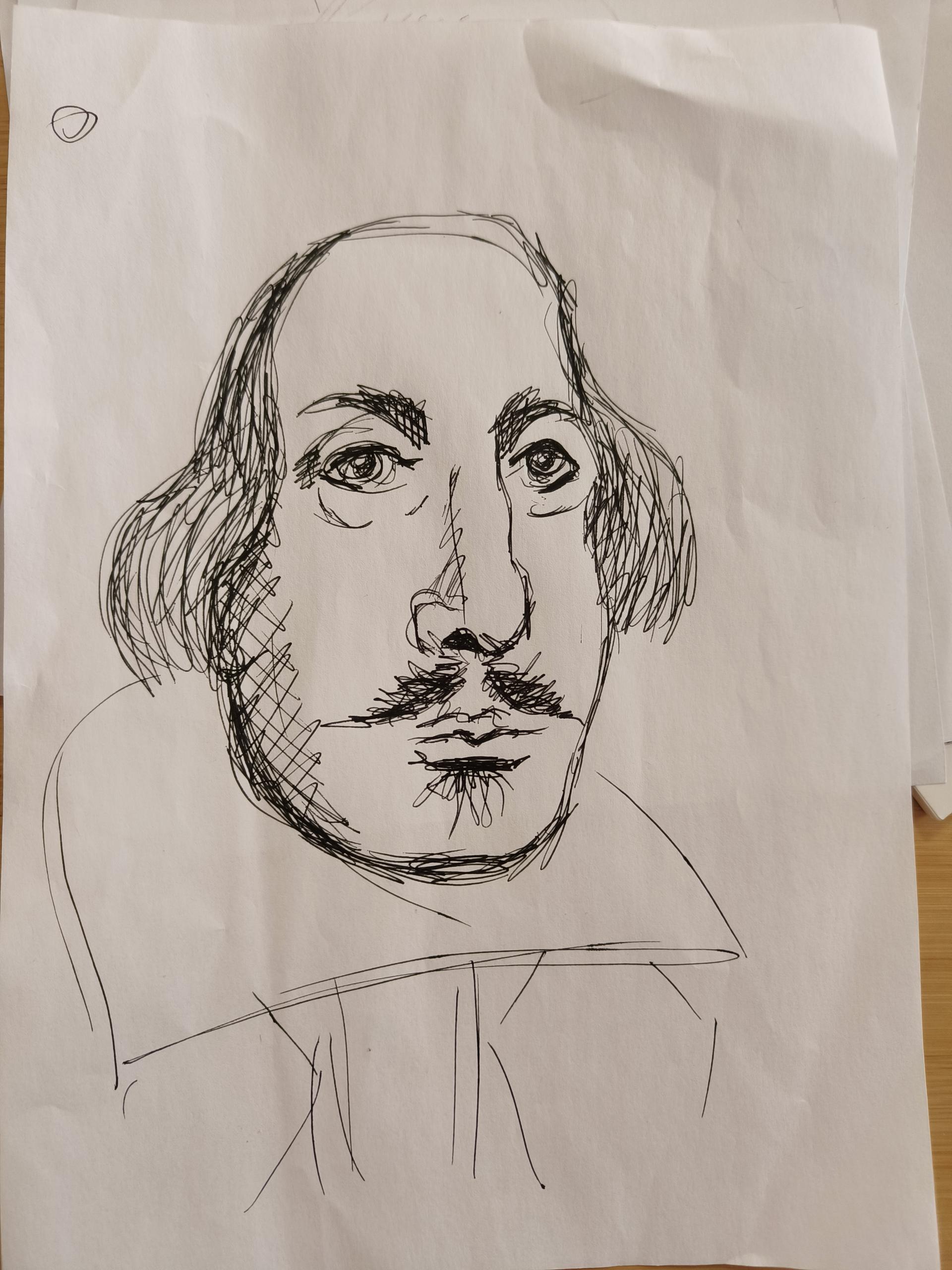
This discussion forum provides a space for my Grade 7 and Grade 8 students to discuss their research findings and identify connections on the subject of Shakespeare. other students are, of course, welcome to join the discussion 🙂
What to discuss? Well, here are a few prompts to get you started:
- Share interesting facts about Shakespeare’s life and the Elizabethan/Jacobean era.
- Identify common features of his plays (e.g., use of verse/prose, comedy/tragedy).
- Share relationship diagrams based on the play you’re reading.
- Comment on the status of women in Shakespeare’s plays.
- Share your favourite Shakespeare insults.
- Share Shakespeare memes.
Once comments have appeared below, the discussion can develop by responding to others 😉
Share interesting facts about Shakespeare’s life and the Elizabethan/Jacobean era.
– His son Hamnet died at 11, which influenced his tragedies.
-He worked at the Globe Theatre, an open‑air theatre.
-In Shakespeare’s time, boys played women’s roles.
-The Elizabethan era was under Queen Elizabeth I; Jacobean under King James I.
-The Globe Theatre burned down in 1613 during a play.
-Shakespeare’s acting group was called The King’s Men.
Identify common features of his plays (e.g., use of verse/prose, comedy/tragedy).
-He used verse for important or noble characters.
-He used prose for common people and funny scenes.
-Comedies: usually end happily with weddings.
Tragedies: main characters die at the end.
Histories: about English kings and politics.
-Common themes: love, power, family, revenge, fate.
Shakespeare’s life
William Shakespeare was born on about April 23, 1564, died in 1616. He was John and Mary Shakespeares oldest surviving child. William had three younger brothers, Gilbert, Richard, and Edmund, and two younger sisters: Anne, who died at seven, and Joan.
A few years after he left school, William Shakespeare married Anne Hath in 1512. She was already expecting their first-born child, Susanna, which was a fairly common situation at the time. When they married, Anne was 26 and William was 18. Anne grew up just outside Stratford in the village of Shottery. After marrying, she spent the rest of her life in Stratford.
Elizabeth Era
The Elizabethan Age began with Elizabeth Tudor’s accession to the throne in the 1558 and ended in 1603. It was a golden era of exploration, art, literacy, and intellectual culture to such a degree that it sometimes designated as the “English Renaissance”.
Women status in Shakespeare’s play:
Hermia had more agency. Hippolyta was Amazon queen. She had dignity, but the main power which showed in the public was controlled by Theseus. She observed the rules and rarely challenged male authority.
However, Hermia defied his father and Athenian law. She refused the arranged marriage, and chose to elope rather than accept death or a nunnery. She acted boldly to control her own future.
By contrast, Helena could put down all dignity, even betraying her friend to pursue Demetrius.She was completely controlled by love and others attitude. She dare not resist social rules and make decisions by herself either. In short, she was passive and completely controlled by the social rules and love.
All three lived in Athen were controlled by social rules. Titania, the fairy queen, existed entirely outside the Athenian society. She could rule and control her own territory, argued equally with Oberon, and refused to surrender the changeling boy. Although the love potion controlled her eventually, her natural freedom and power made her situation far more powerful than the women who was trapped by the Athenian society.
Evidence:
Theseus ‘Either to die the death or to abjure
For ever the society of men.
Therefore, fair Hermia, question your desires;
Know of your youth, examine well your blood,
Whether, if you yield not to your father’s choice,
You can endure the livery of a nun,
For aye to be in shady cloister mew’d,
To live a barren sister all your life,
Chanting faint hymns to the cold fruitless moon.
Thrice-blessed they that master so their blood,
To undergo such maiden pilgrimage;
But earthlier happy is the rose distill’d,
Than that which withering on the virgin thorn
Grows, lives and dies in single blessedness.’
Helena ‘And even for that do I love you the more.
I am your spaniel; and, Demetrius,
The more you beat me, I will fawn on you:
Use me but as your spaniel, spurn me, strike me,
Neglect me, lose me; only give me leave,
Unworthy as I am, to follow you.
What worser place can I beg in your love,–
And yet a place of high respect with me,–
Than to be used as you use your dog?’