
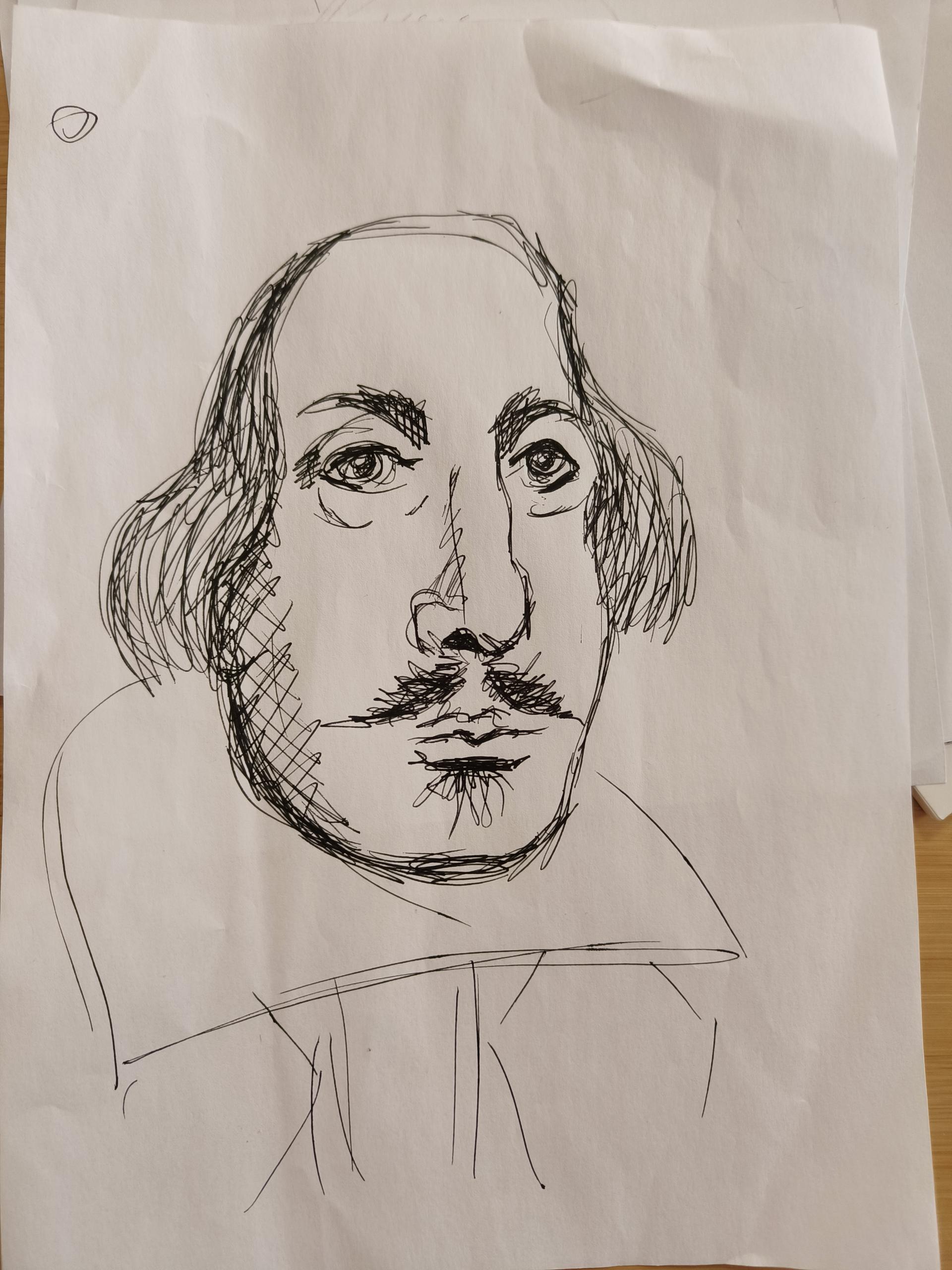
This discussion forum provides a space for my Grade 7 and Grade 8 students to discuss their research findings and identify connections on the subject of Shakespeare. other students are, of course, welcome to join the discussion 🙂
What to discuss? Well, here are a few prompts to get you started:
- Share interesting facts about Shakespeare’s life and the Elizabethan/Jacobean era.
- Identify common features of his plays (e.g., use of verse/prose, comedy/tragedy).
- Share relationship diagrams based on the play you’re reading.
- Comment on the status of women in Shakespeare’s plays.
- Share your favourite Shakespeare insults.
- Share Shakespeare memes.
Once comments have appeared below, the discussion can develop by responding to others 😉
William Shakespeare (1564/4/23-1616/4/23) was an English playwright, poet, and actor. He extents have 39 plays, 154 sonnets, 3 long narrative poems, and a few other verses. The Elizabethan era is the era in the Tudor period of the history of England during the reign of Queen Elizabeth I (1558-1603). Historians often depct it as the golden age in English history. England began to engage in international exploration and cultural expansion. We can saw a flowering of art and literature. Theatres are constantly busy. Elizabethan literature is considered one of the “most splendid” in the history of English literature. However this era has poor public sanitation, rats thrived and also there were many new diseases.
Shakespeare really likes to use several different plot lines with the romantic ones being the central plot line and the comic ones as subplots. He likes to create confusions between characters. He likes plotlines that involves a journey from the civilized world (like the Athenian setting) to magical settings which can isolates and suspends the characters from social norms. He also really likes to use puns, having one direct meaning and a secret meaning, the secret meaning may also foreshadows what will happen in the future of the plot line.
there’s a meme of A Midsummer Night’s Dream
Three unlinked ideas (‘-’)
About Shakespeare’s ending
Most of his work ends with a happy ending, mostly with the lovers getting married. When it comes to bad endings like Hamlet, or when people die or other tragedies occur at the end, he will still write something that makes it fulfilling. For example, in Hamlet, in the end, the person who deserves to be king becomes king(I cannot remember the name)
A little bit about Helena
She is someone very chaotic. First, she chooses who she wants to love on her own and does not listen to Egeus, because he wants Demetrius to marry Hermia instead. But then, when she chases Demetrius, she feels weak and powerless. Her famous quote(I am your spaniel; and, Demetrius,
The more you beat me, I will fawn on you.) also shows how she can give up her dignity for a man.
And also a little bit about the mechanicals
They are just normal people who wish to make some money (not sure) by acting, but they are still drawn into the chaotic scenes of the fairies and the lovers. For example, Bottom is turned into an ass’s head just because Oberon wants to punish Queen Titania. This kinda shows how normal people’s lives and plans get changed by the decisions of the powerful.
Shakespeare (1564 – 1616) was baptized in Stratford-upon-Avon. There were seven “lost years” in his life. He was a co-owner of the Globe Theatre, which was destroyed by fire in 1613, with only six signatures with different spellings of name exist today.
He lived in the era of Elizabeth and James, when all the actors were men, theatres were restricted to the south of the River Thames, social hierarchy was strict and religious conflicts were frequently. The First Folio, published in 1623, preserved 18 plays that would otherwise have been lost.
His plays blend royal and serious scenes with common and comic scenes. Also he makes good use of soliloquies and puns, creating about 1,700 new English words. His works are classified into tragedies (with fatal flaws and tragic endings), comedies (with mistaken identities and happy endings), histories (about English monarchs), and romances (featuring redemption and magic).
He created complex female characters such as Portia, breaking the gender restrictions of his time yet still being constrained by society. Shakespeare’s insults are sharp and absurd, while his works inspire relatable modern memes, reflecting enduring universal themes of love, power, and fate.
“Servant monsters”
“Thy eyes are almost set in thy head.”
“I will supplant some of your teeth”
👹👀🦷
Share interesting facts about Shakespeare’s life and the Elizabethan/Jacobean era.
– His son Hamnet died at 11, which influenced his tragedies.
-He worked at the Globe Theatre, an open‑air theatre.
-In Shakespeare’s time, boys played women’s roles.
-The Elizabethan era was under Queen Elizabeth I; Jacobean under King James I.
-The Globe Theatre burned down in 1613 during a play.
-Shakespeare’s acting group was called The King’s Men.
Identify common features of his plays (e.g., use of verse/prose, comedy/tragedy).
-He used verse for important or noble characters.
-He used prose for common people and funny scenes.
-Comedies: usually end happily with weddings.
Tragedies: main characters die at the end.
Histories: about English kings and politics.
-Common themes: love, power, family, revenge, fate.
Shakespeare’s life
William Shakespeare was born on about April 23, 1564, died in 1616. He was John and Mary Shakespeares oldest surviving child. William had three younger brothers, Gilbert, Richard, and Edmund, and two younger sisters: Anne, who died at seven, and Joan.
A few years after he left school, William Shakespeare married Anne Hath in 1512. She was already expecting their first-born child, Susanna, which was a fairly common situation at the time. When they married, Anne was 26 and William was 18. Anne grew up just outside Stratford in the village of Shottery. After marrying, she spent the rest of her life in Stratford.
Elizabeth Era
The Elizabethan Age began with Elizabeth Tudor’s accession to the throne in the 1558 and ended in 1603. It was a golden era of exploration, art, literacy, and intellectual culture to such a degree that it sometimes designated as the “English Renaissance”.
Women status in Shakespeare’s play:
Hermia had more agency. Hippolyta was Amazon queen. She had dignity, but the main power which showed in the public was controlled by Theseus. She observed the rules and rarely challenged male authority.
However, Hermia defied his father and Athenian law. She refused the arranged marriage, and chose to elope rather than accept death or a nunnery. She acted boldly to control her own future.
By contrast, Helena could put down all dignity, even betraying her friend to pursue Demetrius.She was completely controlled by love and others attitude. She dare not resist social rules and make decisions by herself either. In short, she was passive and completely controlled by the social rules and love.
All three lived in Athen were controlled by social rules. Titania, the fairy queen, existed entirely outside the Athenian society. She could rule and control her own territory, argued equally with Oberon, and refused to surrender the changeling boy. Although the love potion controlled her eventually, her natural freedom and power made her situation far more powerful than the women who was trapped by the Athenian society.
Evidence:
Theseus ‘Either to die the death or to abjure
For ever the society of men.
Therefore, fair Hermia, question your desires;
Know of your youth, examine well your blood,
Whether, if you yield not to your father’s choice,
You can endure the livery of a nun,
For aye to be in shady cloister mew’d,
To live a barren sister all your life,
Chanting faint hymns to the cold fruitless moon.
Thrice-blessed they that master so their blood,
To undergo such maiden pilgrimage;
But earthlier happy is the rose distill’d,
Than that which withering on the virgin thorn
Grows, lives and dies in single blessedness.’
Helena ‘And even for that do I love you the more.
I am your spaniel; and, Demetrius,
The more you beat me, I will fawn on you:
Use me but as your spaniel, spurn me, strike me,
Neglect me, lose me; only give me leave,
Unworthy as I am, to follow you.
What worser place can I beg in your love,–
And yet a place of high respect with me,–
Than to be used as you use your dog?’
Effective analysis, thanks for sharing. This will put you and your readers in a strong position if we write an essay on this topic 👍👍