Shakespeare’s Sonnets

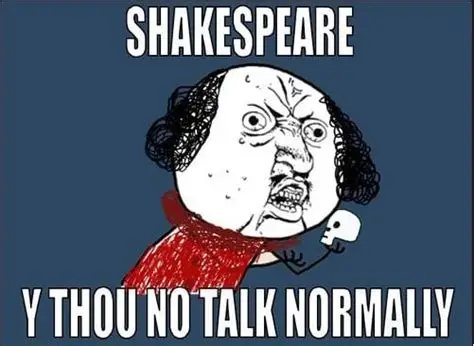
meme

Sonnet 1 From fairest creatures we desire increase, That thereby beauty’s rose might never die, But, as the riper should by time decease, His tender heir might bear his memory. But thou, contracted to thine own bright eyes, Feed’st thy light’s flame with self-substantial fuel, Making a famine where abundance lies, Thyself thy foe, to thy sweet self too cruel. Thou that art now the world’s fresh ornament And only herald to the gaudy spring Within thine own bud buriest thy content And, tender churl, mak’st waste in niggarding.  Pity the world, or else this glutton be—  To eat the world’s due, by the grave and thee. Sonnet 2 When forty winters shall besiege thy brow And dig deep trenches in thy beauty’s field, Thy youth’s proud livery, so gazed on now, Will be a tattered weed of small worth held. Then being asked where all thy beauty lies, Where all the treasure of thy lusty days, To say within thine own deep-sunken eyes Were an all-eating shame and thriftless praise. How much more praise deserved thy beauty’s use If thou couldst answer “This fair child of mine Shall sum my count and make my old excuse,” Proving his beauty by succession thine.  This were to be new made when thou art old  And see thy blood warm when thou feel’st it cold. Sonnet 3 Look in thy glass and tell the face thou viewest Now is the time that face should form another, Whose fresh repair if now thou not renewest, Thou dost beguile the world, unbless some mother. For where is she so fair whose uneared womb Disdains the tillage of thy husbandry? Or who is he so fond will be the tomb Of his self-love, to stop posterity? Thou art thy mother’s glass, and she in thee Calls back the lovely April of her prime; So thou through windows of thine age shalt see, Despite of wrinkles, this thy golden time.  But if thou live remembered not to be,  Die single, and thine image dies with thee. You can learn more about Shakespeare’s poems … Read more
Who is Shakesphere–From Biography.com

William Shakespeare was an English playwright, poet, and actor of the Renaissance era. He was an important member of the King’s Men from roughly 1594 onward. Known throughout the world, Shakespeare’s works, at least 37 plays, 154 sonnets, and 2 narrative poems, captured the range of human emotion and conflict and have been celebrated for more than 400 … Read more

Another bunch of myths

The Lou Carcolh (France)   A mythical beast from French folklore, described as a gigantic, slimy serpent with a shell like a snail, surrounded by hairy tentacles. It lives in deep caves and uses its tentacles to drag in unsuspecting victims. It is a classic “lurking terror” myth, used to keep people from exploring dangerous … Read more

Another bunch of myths

The Toyol (Southeast Asia)   A familiar spirit from Malaysian and Indonesian folklore, often used in black magic. A Toyol is the reanimated fetus or stillborn child of a human, controlled by a master to steal or cause mischief. It appears as a naked, green-skinned child with red eyes. It can be warded off by … Read more

Another Bunch of Myths

The Penanggalan (Malaysia)   A terrifying female vampire from Malay folklore. By day, she appears as a normal woman. At night, her head detaches from her body and flies off, trailing her spine and internal organs, to feed on the blood of newborns or women in childbirth. She is repelled by vinegar, thorns, and glass … Read more

A bunch of myths

DUE TO NOBODY’S SUGGESTION, I STARTED PUTTING 3 MYTHS IN A POST TO AVOID FLODDING THE SITE. The Golem (Jewish Folklore, Central Europe) The Golem is a being created from inanimate matter and brought to life through Hebrew rituals. The Golem is a servant and protector, but it can become mindlessly destructive if not controlled, … Read more

The Kelpie (Scotland)

The Kelpie is a shape-shifting water spirit inhabiting lochs and pools, often appearing as a beautiful tame horse. Once a human, especially a child, mounts it, their skin adheres to the creature, which then drags them into the water to drown and devour them. It is a classic water-horse myth found across Celtic regions.